
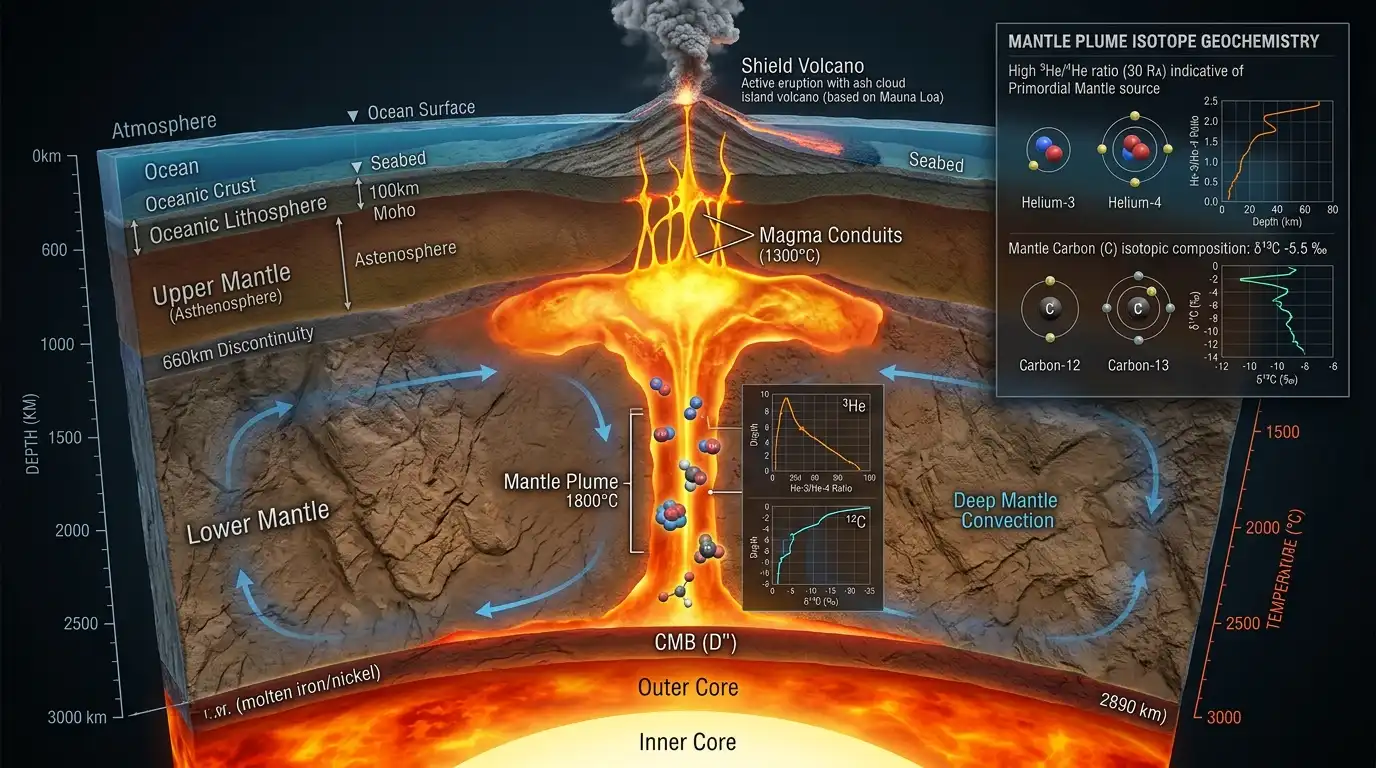
Understanding Earth’s long-term volatile evolution requires looking far beyond the crust, oceans, and atmosphere. While surface carbon cycles rapidly through biological, atmospheric, and oceanic sinks, the vast majority of our planet’s carbon inventory resides deep within the mantle and core. A central, unanswered question in deep Earth science is how much of this deep carbon has been continuously recycled through plate tectonic subduction versus how much represents pristine, primordial carbon retained since Earth’s planetary accretion 4.5 billion years ago.
To distinguish ancient planetary carbon from recycled surface material, geochemists rely on mantle-derived volcanic rocks known as Ocean Island Basalts (OIBs). By analyzing high-precision Helium-3 ($^3\text{He}$) and carbon isotopes ($\delta^{13}\text{C}$) trapped inside mineral olivine inclusions from hotspots like Hawaii, Iceland, and Samoa, researchers can effectively fingerprint primordial mantle carbon reservoirs buried deep near the core-mantle boundary.
The Noble Gas Signature: Helium-3 as a Primordial Clock
Helium is an extraordinary geochemical tracer because it is a non-reactive noble gas that does not participate in chemical bonding. It exists in two primary stable isotopes: Helium-4 ($^4\text{He}$) and Helium-3 ($^3\text{He}$).
- Helium-4 ($^4\text{He}$): Continuously produced throughout Earth’s history by the radioactive alpha decay of heavy elements, primarily Uranium ($^{238}\text{U}$, $^{235}\text{U}$) and Thorium ($^{232}\text{Th}$).
- Helium-3 ($^3\text{He}$): Non-renewable primordial helium trapped within Earth’s interior during planetary formation from the solar nebula. It is not generated in significant quantities by radioactive decay in the solid Earth.
Because Helium-3 is primordial and escaping helium cannot be pulled back into the mantle via subduction (it escapes into outer space), the ratio of $^3\text{He}$ to $^4\text{He}$ acts as a definitive marker of primitive mantle domains. Upper mantle rocks extruded at mid-ocean ridges—known as Mid-Ocean Ridge Basalts (MORBs)—exhibit relatively low, uniform $^3\text{He}/^4\text{He}$ ratios (typically around $8 \pm 1$ times the atmospheric ratio, $R_A$). This reflects an upper mantle that has been extensively degassed and contaminated by radiogenic decay over billions of years.
Conversely, select Ocean Island Basalts derived from deep-seated mantle plumes display exceptionally high $^3\text{He}/^4\text{He}$ signatures, reaching up to 30 to 50 $R_A$ in places like Iceland, Samoa, and the Galápagos. These elevated values demonstrate that mantle plumes tap into an isolated, ancient, undegassed reservoir located far below the convective upper mantle.
Pairing Helium-3 with Carbon Isotopes ($\delta^{13}\text{C}$)
While helium identifies the pristine nature of the mantle source, it cannot directly tell us the chemical concentration or physical behavior of carbon. To complete the picture, geochemists pair noble gas isotopic ratios with stable carbon isotope analysis, expressed as $\delta^{13}\text{C}$ relative to the Vienna Pee Dee Belemnite (VPDB) standard.
Carbon in Earth materials possesses two stable isotopes: $^{12}\text{C}$ (~98.9%) and $^{13}\text{C}$ (~1.1%). Biological processes and low-temperature surface crustal reactions fractionate these isotopes significantly:
- Organic Surface Carbon: Highly enriched in lighter $^{12}\text{C}$, yielding low $\delta^{13}\text{C}$ values between $-20\text{‰}$ and $-30\text{‰}$.
- Marine Carbonates: Enriched in $^{13}\text{C}$, exhibiting $\delta^{13}\text{C}$ values around $0\text{‰}$.
- Average Upper Mantle (MORB): Typically clusters around a canonical value of $-5\text{‰}$ to $-7\text{‰}$.
When analyzing Ocean Island Basalts, separating primordial carbon signatures from recycled subducted carbon requires high-precision isotopic measurements. If a mantle plume exhibits high $^3\text{He}/^4\text{He}$ ratios alongside carbon isotope values that consistently sit at or near canonical mantle values ($\delta^{13}\text{C} \approx -5\text{‰}$), it provides direct evidence that the carbon in that plume is undegassed, accretional carbon sourced from an unmixed primordial domain.
“The coupling of un-radiogenic helium isotope ratios with mantle-like stable carbon isotope ratios in OIB melt inclusions offers unambiguous evidence that domains near the core-mantle boundary have preserved volatile signatures from the earliest stages of terrestrial accretion.”
Microscopic Vaults: Olivine-Hosted Melt Inclusions
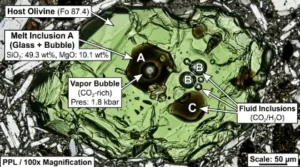
Measuring carbon in mantle-derived magmas presents a major analytical challenge: magma degassing. As a deep mantle plume ascends toward the surface, decreasing pressure causes dissolved carbon dioxide ($\text{CO}_2$) to rapidly exsolve out of the melt, escaping into the atmosphere or forming secondary vesicle bubbles. This degassing process fractionates carbon isotopes, altering the original isotopic signature of the source melt.
Geochemists overcome this obstacle by studying olivine-hosted melt inclusions. Olivine is one of the earliest minerals to crystallize out of high-temperature basaltic magmas at significant depths. As olivine crystals form, they trap tiny droplets of liquid magma inside microscopic pockets.
These olivine hosts act as rigid, high-pressure pressure vessels. They seal the enclosed melt, preventing subsequent degassing, atmospheric contamination, or secondary alteration during magma transport to the surface. By analyzing fluid inclusions and melt pockets inside olivine crystals using high-resolution Secondary Ion Mass Spectrometry (SIMS) and noble gas mass spectrometers, researchers can measure pristine pre-eruptive carbon concentrations and isotope ratios.
For more detailed information on analytical techniques in high-pressure geochemistry, explore research published by the Geochemical Society on volatile extraction and mass spectrometry.
Locating the Primordial Reservoir: LLVPs and the Core-Mantle Boundary
Where are these primordial, helium-3 and carbon-rich reservoirs located within Earth’s interior? Seismic tomography provides vital structural clues that align with geochemical observations.
Seismologists have identified two continent-sized structures sitting at the base of the mantle, roughly 2,900 kilometers beneath our feet, known as Large Low-Velocity Provinces (LLVPs)—located beneath Africa and the Pacific Ocean. These dense, seismically slow structures sit directly above the liquid outer core.
Geochemical models suggest that LLVPs are ancient, chemically distinct piles that have resisted complete mantle convection mixing for over 4 billion years. Deep mantle plumes that fuel hotspot volcanoes—such as those producing Ocean Island Basalts—frequently originate from the roots and margins of these LLVPs. The high $^3\text{He}/^4\text{He}$ ratios and distinct carbon isotope signatures measured in OIBs provide strong geochemical proof that LLVPs act as long-term storage vaults for primordial volatile elements.
Implications for Earth’s Volatile Budget & Planetary Evolution
Fingerprinting primordial mantle carbon using paired helium and carbon isotopes has major implications for planetary science and our understanding of how terrestrial planets evolve:
- Preservation of Planetary Accretion History: It confirms that mantle convection is not fully chaotic or homogenized; isolated pockets of primitive planetesimal material have survived intact despite 4.5 billion years of thermal processing.
- Quantifying Total Carbon Inventories: Demonstrating that deep mantle plumes carry primitive carbon allows geoscientists to more accurately estimate Earth’s deep carbon-to-nitrogen and carbon-to-helium ratios, providing tighter constraints on the total deep Earth carbon mass.
- Comparative Planetology: Understanding how Earth held onto its interior volatile inventory despite giant impacts—such as the Moon-forming collision—helps scientists evaluate volatile retention and habitability potential on rocky exoplanets.
By continuing to refine micro-analytical techniques on olivine-hosted inclusions in Ocean Island Basalts, geochemists are steadily illuminating the deepest, oldest chapters of our planet’s carbon cycle.