
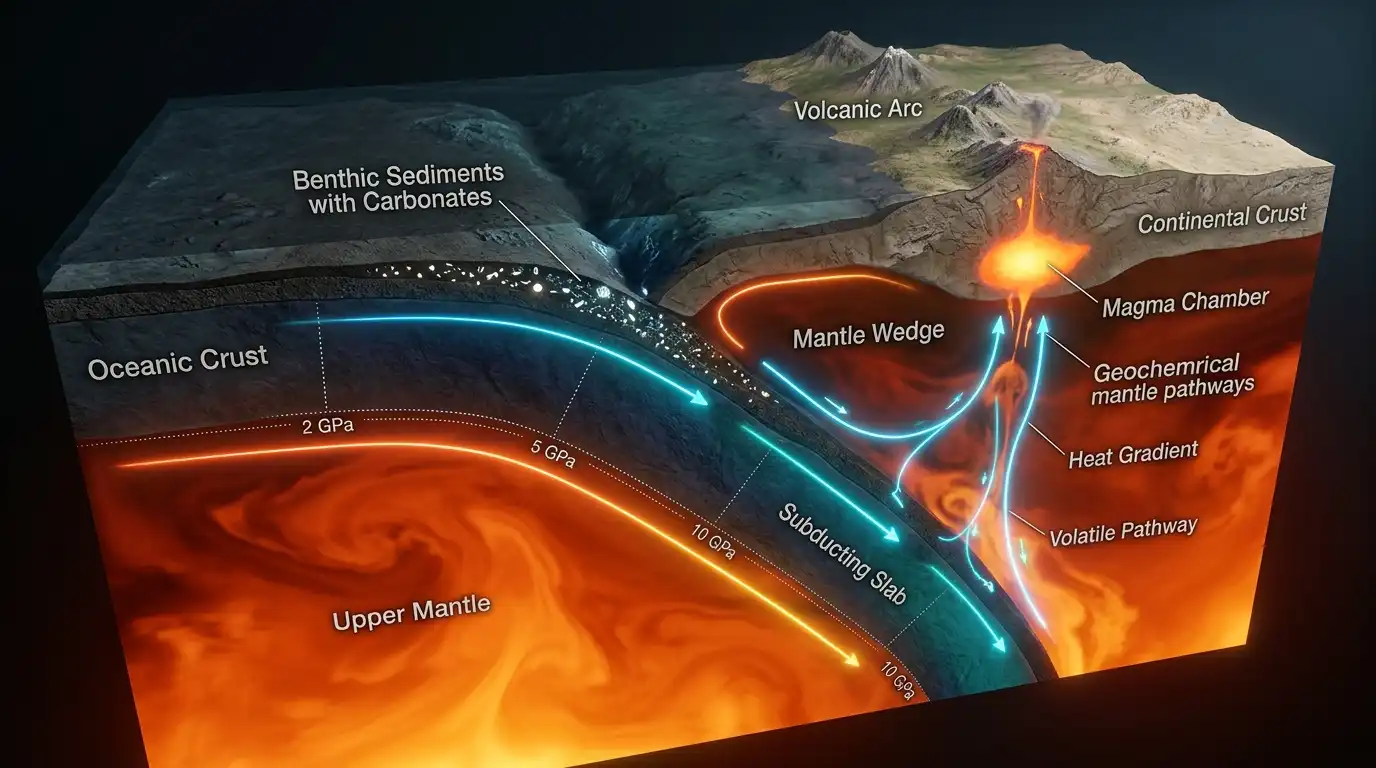
For decades, researchers studying mantle geodynamics focused almost exclusively on natural geological triggers: volcanic outgassing, slab pull, and mantle plume activity. However, emerging marine geological research indicates that anthropogenic disturbances to the ocean floor—specifically deep-sea seabed extraction and industrial bottom trawling—are altering the structural integrity of benthic sediment columns before they ever reach subduction zones.
By disturbing the uppermost benthic layers that store massive quantities of inorganic carbonate and organic carbon, industrial seabed activities risk fundamentally altering the flux of carbon entering Earth’s long-term geochemical mantle reservoir.
1. The Architecture of Deep Carbon Subduction
To understand the impact of seafloor disturbance on mantle dynamics, one must first examine how carbon enters the solid Earth. Oceanic crust acts as a conveyor belt. As tectonic plates spread at mid-ocean ridges, basaltic rock reacts with seawater through hydrothermal alteration, locking carbon into calcium carbonate minerals within the upper oceanic crust.
Over millions of years, as the plate travels across ocean basins, it accumulates a thick mantle of pelagic sediment:
- Inorganic Biogenic Carbonates: Derived from microscopic marine organisms like coccolithophores and foraminifera, whose calcium carbonate ($CaCO_3$) shells settle onto the seabed upon death.
- Organic Carbon: Marine organic matter deposited within fine-grained clay sediment, protected from rapid oxidation by anoxic bottom-water conditions.
- Hydrous Clay Minerals: Mineral matrices that entrap pore water, acting as a fluxing agent during subsequent high-pressure mantle metamorphism.
When the plate reaches a subduction zone, these carbon-bearing layers are forced downward into increasing pressure and temperature regimes. A fraction of this carbon undergoes decarbonation reactions or melting, returning to the surface via arc volcanoes. However, a substantial percentage survives shallow metamorphism, plunging deep into the transition zone and lower mantle, where it contributes to diamond formation and long-term mantle storage.
2. Benthic Trawling and Seabed Extraction: Mechanical Disruption of Carbon Sinks
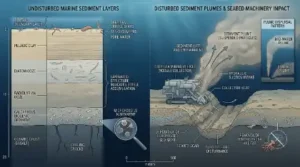
Industrial seabed extractions and deep ocean bottom-trawling operations operate at depths that directly intersect active sediment depositional zones. Heavy machinery dragged across the seafloor or hydraulic collectors stripping polymetallic nodules physically disrupt the top 10 to 50 centimeters of sediment—the precise layer where newly deposited carbon sits prior to long-term lithification.
This physical intervention impacts the deep carbon pathway through three primary mechanisms:
A. Sediment Plume Resuspension and Carbon Oxidation
Seabed machinery generates extensive particulate plumes that suspend ultra-fine sediment into the benthic boundary layer. Once suspended, organic carbon that had been safely buried in anoxic conditions is exposed to oxygenated deep-sea water. Microorganisms rapidly oxidize this resuspend carbon into dissolved inorganic carbon ($CO_2$), shifting it from a long-term geological burial trajectory back into the marine water column.
B. Destruction of Porosity and Hydrological Profiles
Subduction metamorphic reactions depend heavily on the fluid content within subducted sediments. Mechanical compaction from heavy seabed equipment alters sediment porosity and pore-fluid retention. When stripped or compacted sediments eventually reach subduction zones, their altered fluid profiles shift the decarbonation temperature threshold. This causes carbon to volatilize prematurely at shallower depths rather than being carried deep into the mantle matrix.
C. Depletion of the Carbonate Subduction Flux
The total volume of carbon entering the subduction factory is known as the *subduction input flux*. By stripping carbon-rich pelagic clay layers over vast ocean regions, commercial ocean operations diminish the net volume of carbon reaching subduction trenches. Over geological timeframes, this reduction alters the chemical balance between mantle outgassing and carbon subduction.
3. Mantle Geodynamics and Long-Term Geochemical Shifts
Global mantle dynamics relies on an intricate balance between the outgassing of volatile compounds at mid-ocean ridges and the subduction of volatiles at oceanic trenches. Studies supported by global research initiatives, including the Deep Carbon Observatory, demonstrate that even subtle shifts in subduction input chemistry can cascade into long-term changes in mantle oxidation states.
When carbon flux into the mantle is reduced or structurally altered prior to subduction, several key deep processes are affected:
- Mantle Redox Variations: Subducted carbon acts as a major redox buffer in the upper mantle. Carbonates carry oxidized oxygen species into reduced mantle regimes, influencing the oxidation state of mantle peridotites.
- Diamond Nucleation Dynamics: Super-deep diamonds form from carbon-rich fluids derived from subducted slabs in the mantle transition zone ($400\text{–}670\text{ km}$ depth). Altering the isotopic composition and availability of subducted carbon shifts the thermodynamic conditions required for deep mantle diamond crystallization.
- Volcanic Outgassing Stoichiometry: If carbon is remobilized in the water column rather than subducted, arc volcanoes receive altered volatile ratios, changing the composition of gases released into the atmosphere over evolutionary timescales.
Geodynamic Insight: The deep carbon cycle operates over vast spatial and temporal scales, but its inputs are established within the uppermost meters of marine sediment. Mechanical disruption at the ocean floor breaks the vital link between surface biological productivity and deep mantle sequestration.
4. Integrating Seabed Protection into Earth System Models
Historically, deep-sea conservation discussions focused almost exclusively on marine biology and ecosystem protection. However, modern geodynamic research underscores the need to incorporate seabed physical dynamics into Earth System models and mantle carbon budgets.
To preserve the natural efficiency of the subduction carbon sink, international policy frameworks must consider:
- Subduction Zone Protected Areas (SZPAs): Establishing protected marine sanctuaries specifically along active trench margins where sediment accumulation rates are highest and subduction pathways are most direct.
- Sediment Impact Assessments: Requiring deep-sea mining operators to model the long-term geochemical fate of disturbed sediment plumes and calculate lost carbon subduction potential.
- High-Resolution Bathymetric Mapping: Utilizing advanced remote sensing to map carbon-rich pelagic deposits across subducting oceanic plates before industrial permits are granted.
Understanding Earth as an interconnected system requires acknowledging that actions on the ocean surface can resonate down into the deep mantle. Safeguarding benthic sediment layers is not merely a matter of marine conservation—it is an essential step in maintaining the long-term geochemical processes that regulate our planet.