
Understanding Oxygen Fugacity and Mantle Redox States
 To understand carbon behavior at extreme depth, geochemists evaluate pressure, temperature, and oxygen fugacity (a thermodynamic measure of chemical oxygen availability). Earth’s mantle is not chemical homogeneous; its oxidation state varies significantly both laterally and vertically with depth.
Near Earth’s surface and within upper mantle regions, oxygen levels are relatively elevated. As pressure increases deeper into the transition zone (410 to 660 kilometers deep) and lower mantle, intrinsic redox conditions become increasingly reduced. This gradient exists largely because mineral crystal structures adapt to extreme pressures by altering how iron atoms are accommodated—a process governed by iron disproportionation reactions in high-pressure silicates.
This dynamic creates distinct geochemical zones where carbon is forced to adopt radically different chemical forms depending on whether the surrounding rocks are relatively oxidized or reduced.
The Redox Switch: Reduced vs. Oxidized Carbon States
The “switch” mechanism functions as a binary gateway for carbon mobility based on local oxidation states:
1. The Reduced Mantle State (Carbon Storage)
In deep mantle environments where oxygen fugacity drops below the iron-wüstite (IW) or metal-saturation threshold, carbon cannot bond with oxygen. Instead, it exists in elemental form or bonds with metals:
- Graphite and Diamond: Elemental carbon precipitates as crystalline graphite at shallower depths or transitions into diamond under high pressures deeper than ~150 kilometers. Solid diamonds can remain securely locked within mantle rocks for billions of years.
- Iron Carbides: In highly reduced zones, carbon reacts directly with metallic iron to form iron carbide compounds ($Fe_3C$), effectively sequestering carbon deep within metallic phases.
In these reduced states, carbon is practically immobile, preventing it from migrating upward into shallow magma systems.
2. The Oxidized Mantle State (Carbon Mobilization)
When oxygen availability rises past a crucial threshold—specifically the Carbon-Carbonate-Antigorite or Enstatite-Magnesite-Olivine-Diamond (EMOD) buffer—carbon oxidizes into carbonate ions ($CO_3^{2-}$). This transition changes everything:
- Carbonate Minerals: Carbon forms solid carbonate phases such as magnesite ($MgCO_3$) or calcite ($CaCO_3$).
- Carbonatite Melts: Under high pressures and temperatures, solid carbonates cause low-degree flux melting, producing ultralow-viscosity carbonate liquid melts. These mobile liquids migrate easily through silicate grain boundaries.
Once oxidized into liquid melt, carbon gains mobility and rapidly ascends toward shallow crustal reservoirs and volcanic centers.
Subduction Zones as Deep Oxidation Pumps
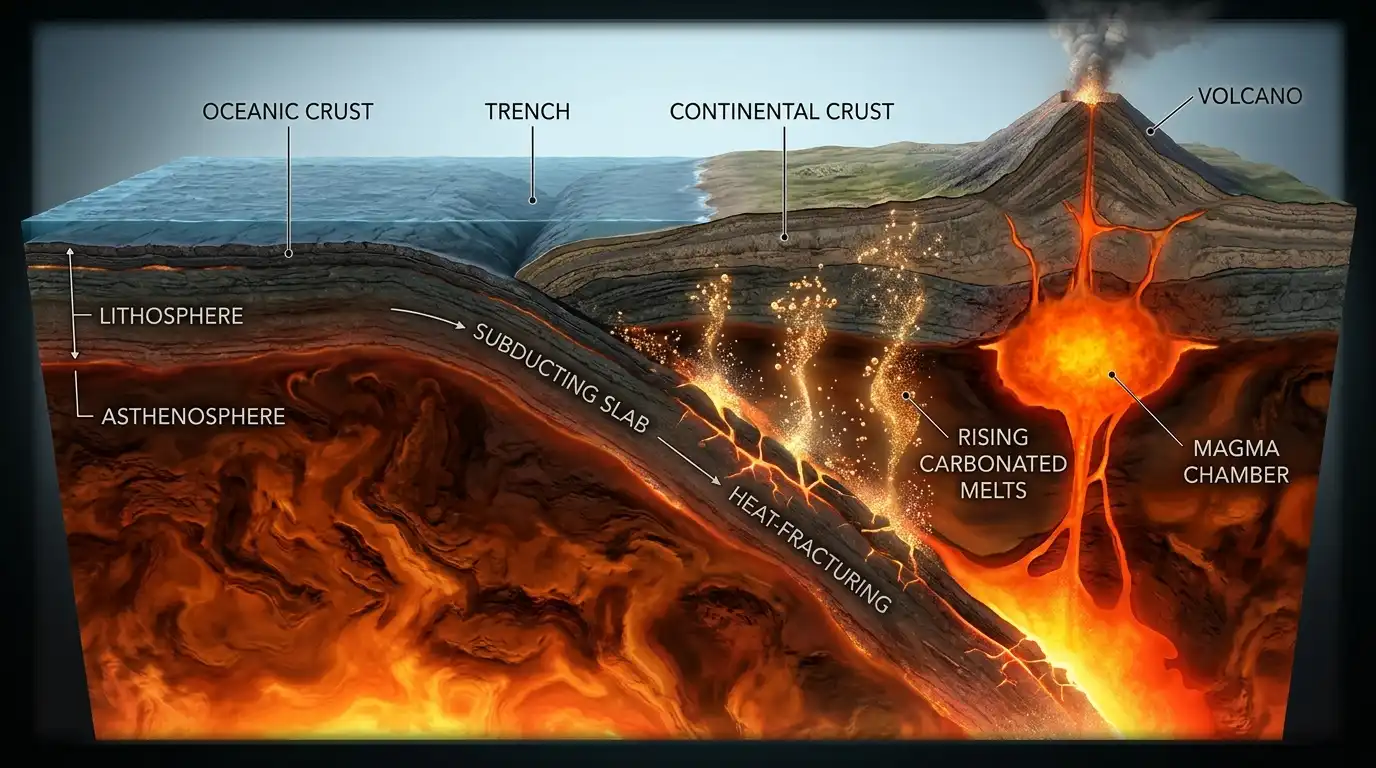
If the deep mantle is naturally reduced, how does oxidized carbon ever form at depth? The primary driver is subduction—the tectonic process where oceanic plates plunge into Earth’s interior.
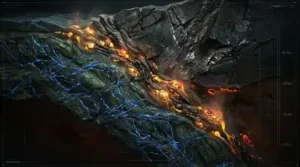
Subducted ocean floor carries surface water, organic matter, and calcium carbonate sediments directly into the mantle. As these cold, oxidized slabs sink, they act as deep chemical pumps, injecting oxygen-rich volatiles into reduced mantle surrounding them. Research documented by the Deep Carbon Observatory reveals that subduction zones act as major gatekeepers, determining whether subducted carbon is recycled back up via arc volcanoes or buried permanently into the deep transition zone.
When cold slab materials heat up, the surrounding mantle experiences a local spike in oxygen fugacity. This “flips” the redox switch, converting solid mantle diamonds or graphite into carbonate liquids that trigger arc volcanism and return $CO_2$ to the atmosphere.
Volcanic Degassing and Planetary Climate Stability
The equilibrium between reduced storage and oxidized degassing regulates Earth’s surface temperature over long geological timescales. Without mantle degassing, Earth’s atmosphere would gradually lose $CO_2$ through weathering processes, leading to global cooling and frozen climate states.
Conversely, major mantle plumes rising from the core-mantle boundary can cross chemical interfaces, rapidly oxidizing deep carbon reservoirs. When giant upwellings melt carbonated mantle rocks, they generate massive volcanic events known as Large Igneous Provinces (LIPs). The rapid degassing of $CO_2$ during these events has been linked to major palaeoclimate shifts and mass extinction episodes throughout Earth’s history.
How Geologists Probe the Deep Redox Switch
Because scientists cannot directly sample the deep mantle, understanding mantle redox conditions requires indirect analytical methods:
- Super-Deep Diamonds: Rare sub-lithospheric diamonds formed between 300 and 800 kilometers deep trap mineral inclusions during crystallization. Analyzing inclusion chemistry reveals the exact oxygen fugacity and pressure conditions present during diamond formation.
- Mantle Xenoliths: Pieces of deep mantle rock brought rapidly to the surface inside kimberlite pipe eruptions allow geochemists to measure iron oxidation states ($Fe^{3+}/\Sigma Fe$) in mantle minerals directly.
- High-Pressure Experiments: Using multi-anvil presses and diamond anvil cells, laboratory researchers recreate upper and lower mantle pressure-temperature conditions to observe carbon phase changes in real time.
Conclusion: A Deep Engine Governing Surface Life
Earth’s climate stability is not governed solely by surface processes; it is deeply intertwined with the redox chemistry of our planet’s interior. By toggling carbon between immobile solids and mobile carbonate melts, mantle oxygen levels operate an invisible chemical switch that dictates the pace of volcanic degassing.
As geoscientists continue to map mantle oxidation states and track deep carbon pathways, we gain a clearer understanding of how Earth has successfully maintained a stable, habitable climate for billions of years.