
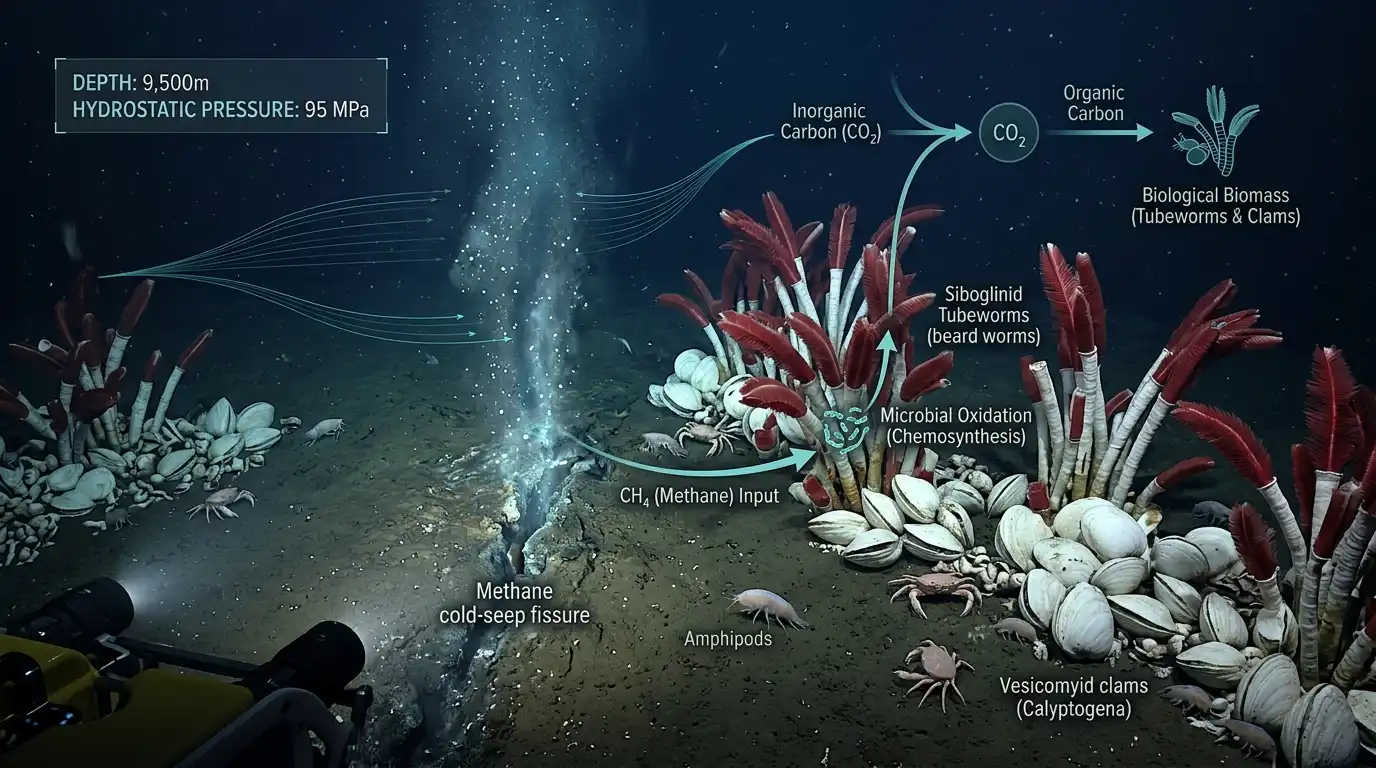
Historically, oceanographic models treated these ultra-deep V-shaped depressions as passive biological deserts reliant almost entirely on the “biological pump.” However, global research initiatives under the Deep Carbon Observatory have shown that subduction zones host complex volatile networks. The ocean’s hadal zone—encompassing deep oceanic trenches from 6,000 to nearly 11,000 meters depth—represents one of the most geologically dynamic yet least understood frontiers in planetary geochemistry. Historically, oceanographic models treated these ultra-deep V-shaped depressions as passive biological deserts reliant almost entirely on the “biological pump.” Under this traditional view, the sparse benthic life in hadal trenches was thought to subsist on the minimal fraction of organic marine snow that survived the long descent from sunlit surface waters. Recent deep-submersible expeditions targeting trench systems across the Pacific Rim—including the Kuril-Kamchatka, Aleutian, Kermadec, and Mariana trenches—have upended this paradigm. Researchers using advanced crewed submersibles have documented extensive, flourishing chemosynthetic ecosystems at record-breaking depths exceeding 9,500 meters. Sustained by methane-rich and hydrogen sulfide-rich fluid seeps issuing from tectonic fault networks, these deep-sea oases convert inorganic chemical energy into organic biomass. This discovery forces a fundamental reevaluation of the global deep carbon cycle, revealing that subduction trenches act not merely as passive conduits carrying carbon into the mantle, but as active bioreactors that intercept, transform, and store vast volumes of organic carbon.
Tectonic and Geochemical Drivers of Hadal Cold Seeps
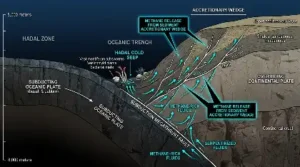 Hadal cold seeps differ fundamentally from shallow shelf or continental margin gas outlets. In subduction zones, as an oceanic plate flexes and descends beneath an overriding tectonic plate, immense compressional and shear stresses fracture the sedimentary wedge and subducting lithosphere. This intense deformation generates deep-seated fault systems that serve as high-permeability conduits for fluids trapped deep within the sediment column.
Methane venting in hadal trenches originates through two distinct geochemical pathways:
- Microbial Methanogenesis: In organic-rich trench fill sediments, anaerobic archaea decompose buried organic matter, generating biogenic methane characterized by light carbon isotope signatures ($\delta^{13}\text{C-CH}_4$).
- Abiotic Serpentinization: Where seawater penetrates deep into mantle peridotite along slab bend faults, hydration reactions convert olivine into serpentinites, producing hydrogen gas that reacts with dissolved carbon to synthesize abiotic methane through Fischer-Tropsch-type reactions.
Driven by tectonic compaction and fluid overpressure, these hydrocarbon-rich fluids migrate laterally and vertically along fault planes, discharging onto the abyssal trench floor under hydrostatic pressures exceeding 90 to 100 megapascals (MPa).
Chemosynthetic Carbon Fixation and Methanotrophic Pathways
In total darkness and at temperatures hovering near freezing, Primary organic production at hadal seeps relies exclusively on chemosynthesis. Free-living and endosymbiotic microbes utilize the chemical potential energy stored in methane ($\text{CH}_4$) and hydrogen sulfide ($\text{H}_2\text{S}$) to fix dissolved inorganic carbon ($\text{DIC}$) into complex carbohydrates.
The primary engine driving this ecosystem is the Anaerobic Oxidation of Methane (AOM), carried out by syntrophic consortia of anaerobic methanotrophic archaea (ANME) and sulfate-reducing bacteria (SRB). The overall biogeochemical reaction can be expressed as:
$$\text{CH}_4 + \text{SO}_4^{2-} \rightarrow \text{HCO}_3^- + \text{HS}^- + \text{H}_2\text{O}$$
This process produces bicarbonate ($\text{HCO}_3^-$) and hydrogen sulfide ($\text{HS}^-$). Bicarbonate ions react with ambient calcium in seawater to precipitate authigenic carbonate minerals ($\text{CaCO}_3$), permanently locking carbon into the seafloor geology. Meanwhile, the generated hydrogen sulfide fuels sulfur-oxidizing endosymbionts hosted inside specialized tissues of dense animal populations—most notably siboglinid tubeworms (such as frenulate and vestimentiferan species) and vesicomyid or thyasirid bivalves.
Stable carbon isotope analysis ($\delta^{13}\text{C}$) confirms that these benthic organisms derive their structural carbon directly from local methanotrophic pathways rather than photosynthetic surface detritus. By converting dissolved methane into dense biological tissues and carbonate crusts, these microbial communities form the foundation of a robust hadal food web.
Quantifying the Hadal Chemosynthetic Carbon Mass Balance
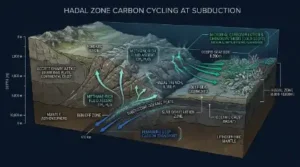 The discovery of continuous chemosynthetic fields spanning thousands of kilometers along subduction trench axes requires geochemists to recalculate the mass balance of carbon entering subduction zones. Historically, subduction carbon input models assumed that all carbon stored in pelagic sediments either descended into the mantle transition zone or was liberated at subarc depths through dehydration melting and volcanic outgassing.
Factoring hadal chemosynthetic systems into global subduction budgets introduces three major carbon fluxes:
- Methane Interception and Biological Retention: Microbial mats and endosymbiotic fauna convert a substantial fraction of ascending volatile methane into refractory organic matter, preventing potent greenhouse gases from escaping into the abyssal water column.
- Authigenic Carbonate Sink: AOM-driven precipitation creates extensive pavements of authigenic carbonate, transferring fluid-phase carbon into stable mineral phases that are subsequently dragged deeper into the accretionary wedge or subducted into the upper mantle.
- Benthic Carbon Accumulation: Organic carbon synthesized at hadal seeps accumulates in localized trench topographic lows, creating high-density carbon hotspots that bypass standard pelagic degradation rates.
By capturing ascending volatile fluids near the seafloor surface, hadal chemosynthetic communities establish a recycling loop that delays or alters the delivery of subducted carbon to deeper mantle reservoirs.
Reframing Planetary Carbon Dynamics and Subduction Fluxes
Integrating hadal trench cold seeps into Earth system science bridges the gap between surface climate regimes and deep mantle reservoirs. Recognizing that subduction trenches harbor high-capacity microbial filter systems reshapes our understanding of volatile degassing over geological timescales.
Because methane and hydrogen sulfide venting is modulated by tectonic activity, major seismic events and fault slip cycles directly influence the rate of chemosynthetic carbon fixation on the deep ocean floor. During periods of intensified subduction or major megathrust ruptures, accelerated fluid venting boosts chemosynthetic biological production, increasing the rate of authigenic carbonate trapping. Conversely, quiescent tectonic intervals may lead to reduced fluid supply and temporary localized senescence of seep communities.
Understanding these deep-sea biological and geochemical buffers is essential for refining long-term planetary carbon budgets. As deep-sea exploration tools continue to advance, documenting the distribution and isotopic signatures of hadal cold seeps will remain a cornerstone in decoding the co-evolution of tectonic plates, deep oceanic life, and Earth’s climate stability.