
Introduction: Beyond Temporary Carbon Band-Aids
The global race to achieve net-zero carbon emissions has sparked an explosion of innovation in Carbon Dioxide Removal (CDR). From planting forests to spinning up massive Direct Air Capture (DAC) fans, the world is desperately searching for ways to scrub billions of tons of $\text{CO}_2$ from our atmosphere. However, many contemporary solutions suffer from a fundamental flaw: permanence.
Trees can burn in wildfires; soil carbon can be re-released through shifting agricultural practices; and even shallow underground storage reservoirs carry marginal risks of leakage over centuries. To truly stabilize our climate, we need a solution that locks carbon away not for decades, or even centuries, but for millions of years.
Enter the combination of Enhanced Rock Weathering (ERW) and Deep Mantle Sequestration. By accelerating the Earth’s natural thermostat and bridging the surface carbon cycle with the deep planet, this paradigm shift offers the ultimate, permanent geological sink. Here is how ERW acts as the critical direct bridge to pushing carbon back where it belongs: deep into the Earth’s mantle.
Understanding the Surface Engine: Enhanced Rock Weathering (ERW)
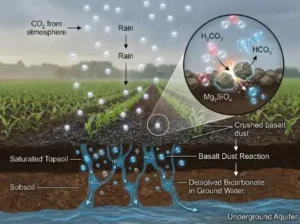
Before we can bridge carbon to the mantle, we must first capture it on the surface. Nature has been doing this for eons through a process called silicate weathering. When rain falls, it absorbs atmospheric $\text{CO}_2$, forming a weak acid called carbonic acid ($\text{H}_2\text{CO}_3$). When this rain hits silicate rocks—such as basalt—it triggers a chemical reaction that breaks down the rock and traps the carbon.
The Simplified Chemical Formula:
$$\text{Mg}_2\text{SiO}_4 \text{ (Olivine)} + 4\text{CO}_2 + 4\text{H}_2\text{O} \rightarrow 2\text{Mg}^{2+} + 4\text{HCO}_3^- + \text{H}_4\text{SiO}_4$$
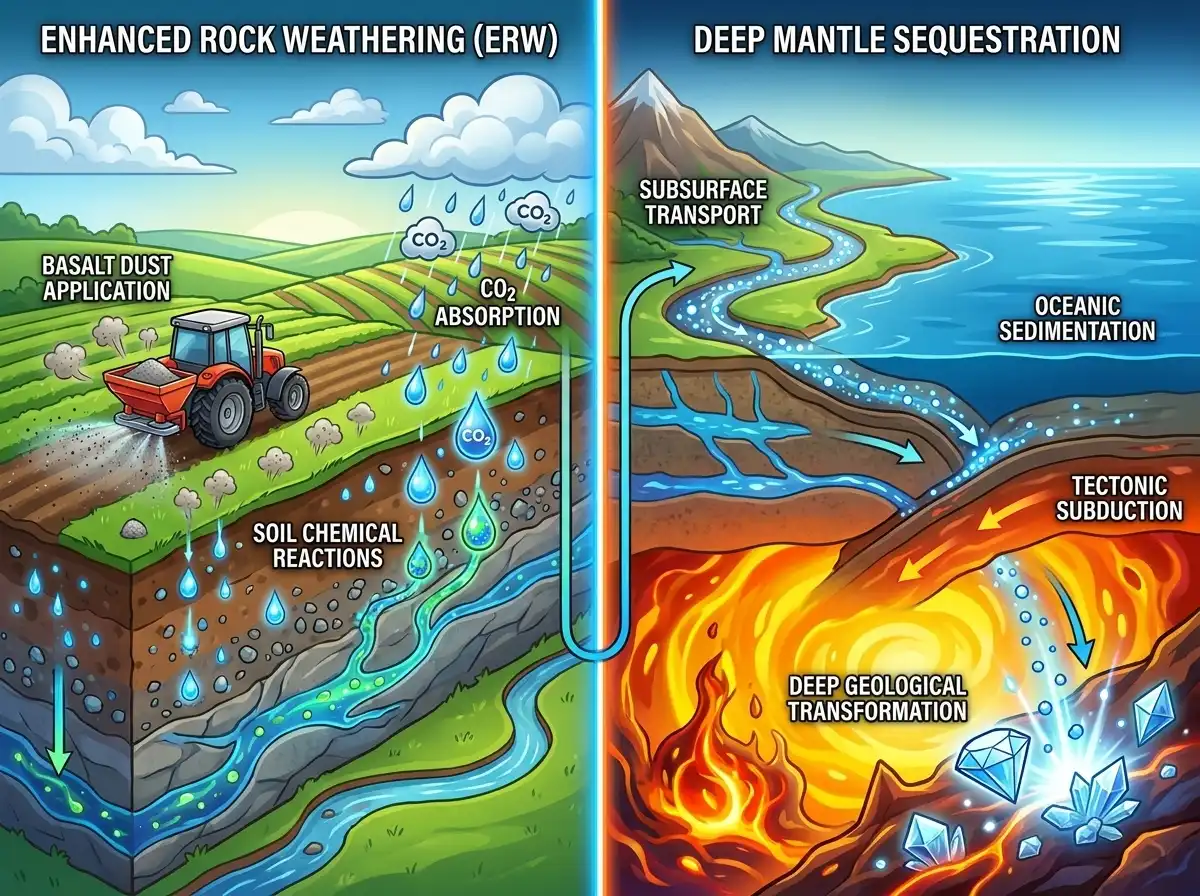
In nature, this process takes hundreds of thousands of years. Enhanced Rock Weathering intentionally accelerates this timeline. By crushing silicate-rich rocks into a fine powder, we exponentially increase their surface area. When spread across vast agricultural fields or coastal regions, this dust reacts with rain and soil moisture, capturing atmospheric carbon and converting it into stable, dissolved bicarbonate ions ($\text{HCO}_3^-$) within a matter of months or years.
The Sub-Surface Journey: From Soil to Subduction Zones
Once ERW locks atmospheric carbon into a liquid bicarbonate state, the true magic of the “bridge” begins. These dissolved carbonates don’t just sit in the soil. Rainwater flushes them into groundwater systems, which eventually empty into rivers, and ultimately, the world’s oceans.
In the marine environment, these bicarbonate ions are utilized by calcifying organisms (like corals and shellfish) to build shells, or they spontaneously precipitate out of the water as solid calcium carbonate ($\text{CaCO}_3$) or magnesium carbonate ($\text{MgCO}_3$). Over millennia, these minerals settle onto the ocean floor, forming thick layers of marine carbonate sediments.
The Tectonic Conveyor Belt
The ocean floor is not static. Thanks to plate tectonics, oceanic crust acts as a massive, slow-moving conveyor belt. As oceanic plates drift, they eventually collide with lighter continental plates at boundaries known as subduction zones. Here, the heavy oceanic crust—carrying its newly acquired payload of carbon-rich sedimentary rock—is forced downward, diving deep into the Earth’s mantle.
Deep Mantle Sequestration: The Multi-Million-Year Vault
As the subducting plate plunges tens to hundreds of kilometers beneath the surface, it enters the extreme temperature and pressure environment of the mantle. Under these conditions, the captured carbon undergoes profound metamorphic changes.
While some carbon is outgassed back to the surface via volcanic eruptions, a substantial fraction resists vaporization. Instead, it undergoes high-pressure chemical reactions to form dense carbonate minerals or even locks away into deep-seated diamonds. This carbon becomes integrated directly into the ambient mantle matrix.
Why is deep mantle sequestration the holy grail of carbon storage? Because the turnover time of the deep mantle is measured in hundreds of millions of years. Once carbon crosses the threshold into the deep earth, it is effectively removed from the biosphere’s active loop. It is completely isolated from the atmosphere, oceans, and surface ecosystems, eliminating any risk of sudden, catastrophic re-release.
Connecting the Dots: ERW as the Critical Enabler
It is easy to view ERW and plate tectonics as two entirely separate phenomena. However, looking at them through a systems-engineering lens reveals that ERW is the necessary catalyst to kickstart this deep geological sequestration. Without ERW, the natural drawdown of carbon to feed the tectonic conveyor belt is simply too slow to counter anthropogenic emissions.
The following table illustrates why bridging these two concepts changes the calculus of climate mitigation:
| Storage Strategy | Permanence / Lifespan | Capacity Limit | Risk of Leakage |
|---|---|---|---|
| Biomass (Forests/Soil) | Decades to Centuries | Low to Moderate | High (Wildfires, land use changes) |
| Engineered Reservoirs (CCS/DAC) | Thousands of Years | Moderate to High | Low (Barring seismic/structural failure) |
| ERW to Deep Mantle Bridge | Millions of Years | Virtually Limitless | Zero (Permanently bound in deep geology) |
Challenges and Future Outlook
While the conceptual pathway of Enhanced Rock Weathering to Deep Mantle Sequestration is robust, scaling it to a gigaton level requires navigating several engineering and economic hurdles:
- Energy & Mining Footprint: Crushing and transporting billions of tons of basalt or olivine requires immense energy. To be truly net-negative, the machinery and logistics networks must be powered entirely by renewable energy.
- Verification (MRV): Accurately measuring exactly how much carbon has been captured and dissolved into aquatic systems via ERW remains a complex task that requires sophisticated modeling and sensor networks.
- Accelerating the Bridge: While ERW speeds up the surface capture phase, the tectonic transport to the mantle still operates on geological timescales. Researchers are currently exploring whether targeted deep-well injection into onshore basaltic or peridotite formations can fast-track the mineral crystallization process, effectively skipping the ocean-conveyor step.
Conclusion: Aligning with Earth’s Deep Cycles
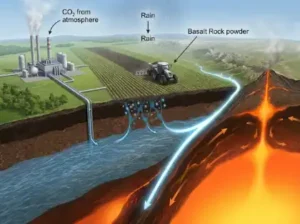 Humanity’s current climate crisis stems from a disruption of the global carbon balance—we have rapidly extracted carbon from the deep geological reserves (fossil fuels) and dumped it into the shallow surface atmosphere.
Enhanced Rock Weathering combined with Deep Mantle Sequestration offers an elegant, mirror-image solution. It utilizes the agricultural and industrial infrastructure of the surface to capture carbon rapidly, then strategically feeds it into the planet’s natural crustal recycling systems. By acting as a direct bridge to the deep mantle, ERW doesn’t just rent us time; it permanently resets the Earth’s long-term thermostat, providing a definitive answer to the planetary challenge of carbon storage.