
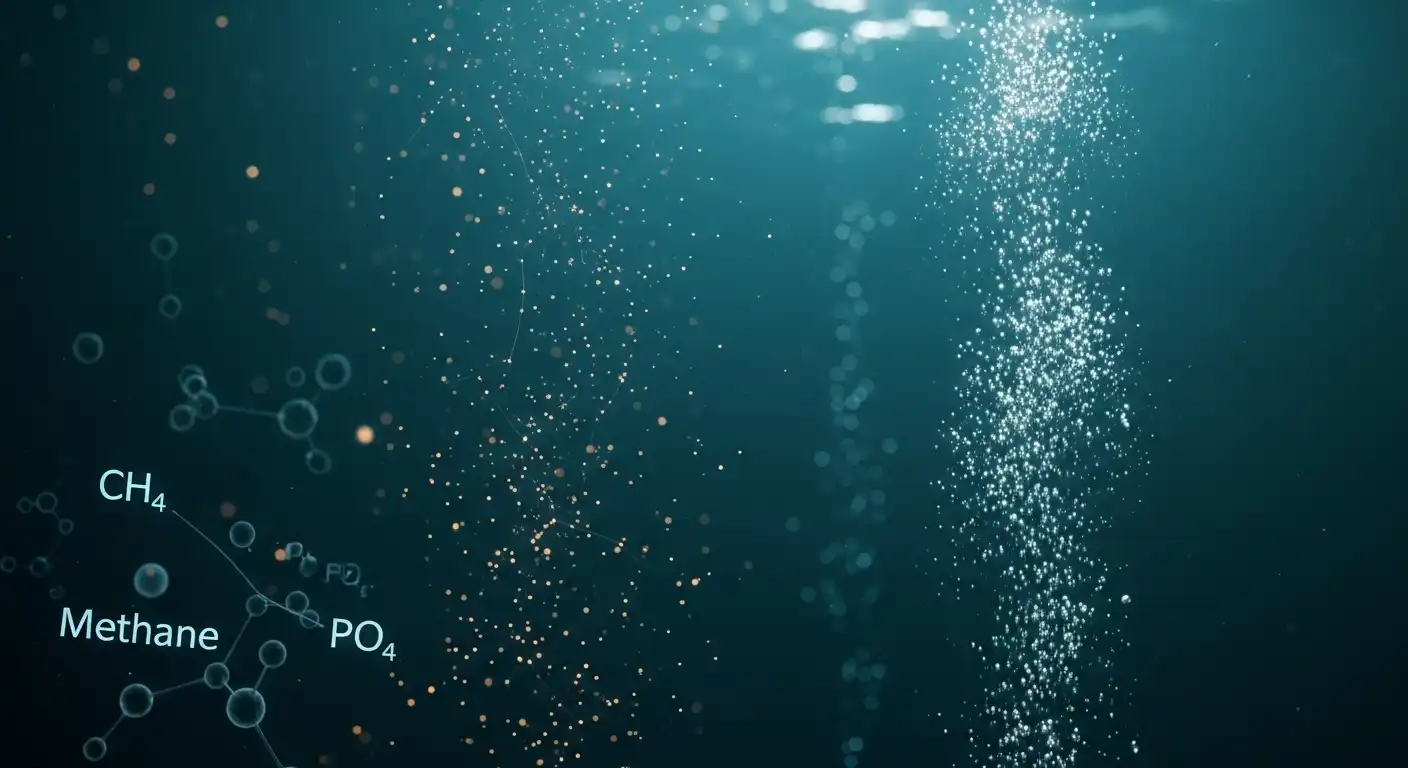
For decades, the deep carbon cycle has been viewed largely through the lens of geological time—carbon subducting into the mantle and returning via volcanic outgassing. However, in April 2026, a landmark study published in the Proceedings of the National Academy of Sciences (PNAS) has shifted our focus to the “Blue Frontier.” Scientists at the University of Rochester have finally identified a “hidden” methane source in the open ocean that fundamentally accelerates our understanding of global warming.
This discovery resolves the long-standing “Marine Methane Paradox”: Why do oxygen-rich surface waters, which should technically inhibit methane production, consistently release this potent gas into our atmosphere? The answer lies in a microscopic struggle for survival and a critical nutrient “control knob”: Phosphate.
The Phosphate Scarcity Trigger: Solving the Paradox
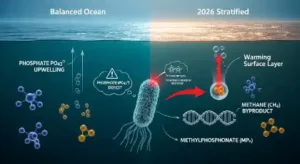 In the vast, nutrient-poor regions of the open ocean known as subtropical gyres, microbes face a constant shortage of phosphorus (PO₄³⁻), an essential building block for DNA and energy. The April 2026 research reveals that when phosphate levels drop to critical lows, specific marine bacteria pivot their metabolic processes to survive.
These microbes begin utilizing an enzyme called C-P lyase to break down methylphosphonate (MPn)—a phosphorus-containing organic compound produced by phytoplankton. While this allows the bacteria to extract the phosphorus they need, the chemical “waste product” of this reaction is methane (CH₄). Because this occurs in the upper 50 to 100 meters of the ocean, over 90% of the methane produced escapes into the atmosphere before it can be oxidized by other bacteria.
A New Carbon Cycle Feedback Loop for 2026
The implications for the global carbon cycle are profound. Methane is significantly more potent than carbon dioxide at trapping heat in the short term. The University of Rochester study identifies a terrifying new positive feedback loop that is currently missing from major climate models:
- Ocean Stratification: Climate change warms the ocean from the top down, making the surface layer less dense. This “cap” of warm water prevents the vertical mixing that usually carries phosphate-rich cold water from the deep to the surface.
- Nutrient Starvation: As surface waters become increasingly depleted of phosphate, microbes are forced to switch to methylphosphonate degradation.
- Methane Surge: This metabolic shift triggers a surge in methane emissions directly into the atmosphere.
- Amplified Warming: The extra methane accelerates global warming, which further warms the ocean surface, strengthening the stratification and starting the cycle again.
Connecting the Deep Cycle to the Surface
While much of our work at deepcarboncycle.org explores geological carbon sequestration, this discovery highlights that the “deep” and “surface” cycles are part of a singular, interconnected engine. The phosphate that feeds surface microbes is often the result of millennial-scale upwelling—a mechanical part of the planetary carbon pump.
If the deep-to-surface nutrient pipeline is severed by rapid atmospheric warming, the biological pump that traditionally sequesters carbon may instead become a methane chimney. This underscores the urgent need for “Earth System Digital Twins”—real-time models that can track these microscopic shifts across global basins to predict our climate’s true trajectory.
Scientific Insight: This methane isn’t leaking from deep-sea vents or melting clathrates; it is being “manufactured” in the sunlit zone by the very life forms we rely on to balance our planet’s chemistry.
The Role of Technical Innovation in Climate Solutions
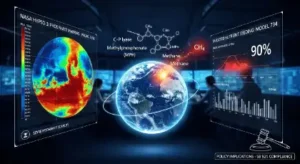 As we move through 2026, the scientific community is prioritizing “Bio-Forensics” to monitor these hot zones. Just as we use data to prove liability in transport accidents or track safety compliance on construction sites, we must now use satellite-based sensors to map phosphate scarcity in real-time.
Understanding these invisible threads is the only way to safeguard our climate future. Whether we are decoding the secrets of the microbial abyss or adapting our legal systems to a changing world, the goal remains the same: a stable, sustainable Earth.
Want to stay updated on the latest breakthroughs in Earth science? Subscribe to our newsletter for deep-dives into the mechanisms that power our planet.