
The Earth’s climate is governed by a vast, interconnected series of chemical exchanges known as biogeochemical cycles. Among these, the movement of carbon between the atmosphere, the oceans, and the deep interior of the planet plays a monumental role in stabilizing global temperatures over geological timescales. While much attention is focused on atmospheric carbon dioxide, the world’s oceans act as the planet’s primary active reservoir, sequestering immense volumes of carbon far away from the atmosphere.
Understanding how carbon travels from sunlit surface waters down to the abyssal plain—and eventually into the Earth’s mantle—requires examining one of the most powerful mechanisms in oceanography: the biological pump. For researchers and earth scientists studying the marine carbon cycle, tracking this descent bridges surface ecology with deep-Earth geodynamics.
The Ocean as a Global Carbon Sink
The global oceans contain roughly 50 times more carbon than the atmosphere. This vast reservoir is maintained by two primary mechanisms working in tandem: the solubility pump and the biological pump.
The solubility pump is driven by physical and chemical processes. Cold polar waters absorb carbon dioxide from the atmosphere more readily than warm tropical waters. As these cold surface waters become dense, they sink into the deep ocean, carrying dissolved inorganic carbon (DIC) down into the abyssal circulation currents.
However, the biological pump adds a biological engine to this physical conveyor belt. Driven by microscopic marine organisms, this pump actively fixes carbon dioxide into organic matter in the sunlit surface layer and exports it toward the ocean floor.
Phytoplankton and the Initiation of the Biological Pump
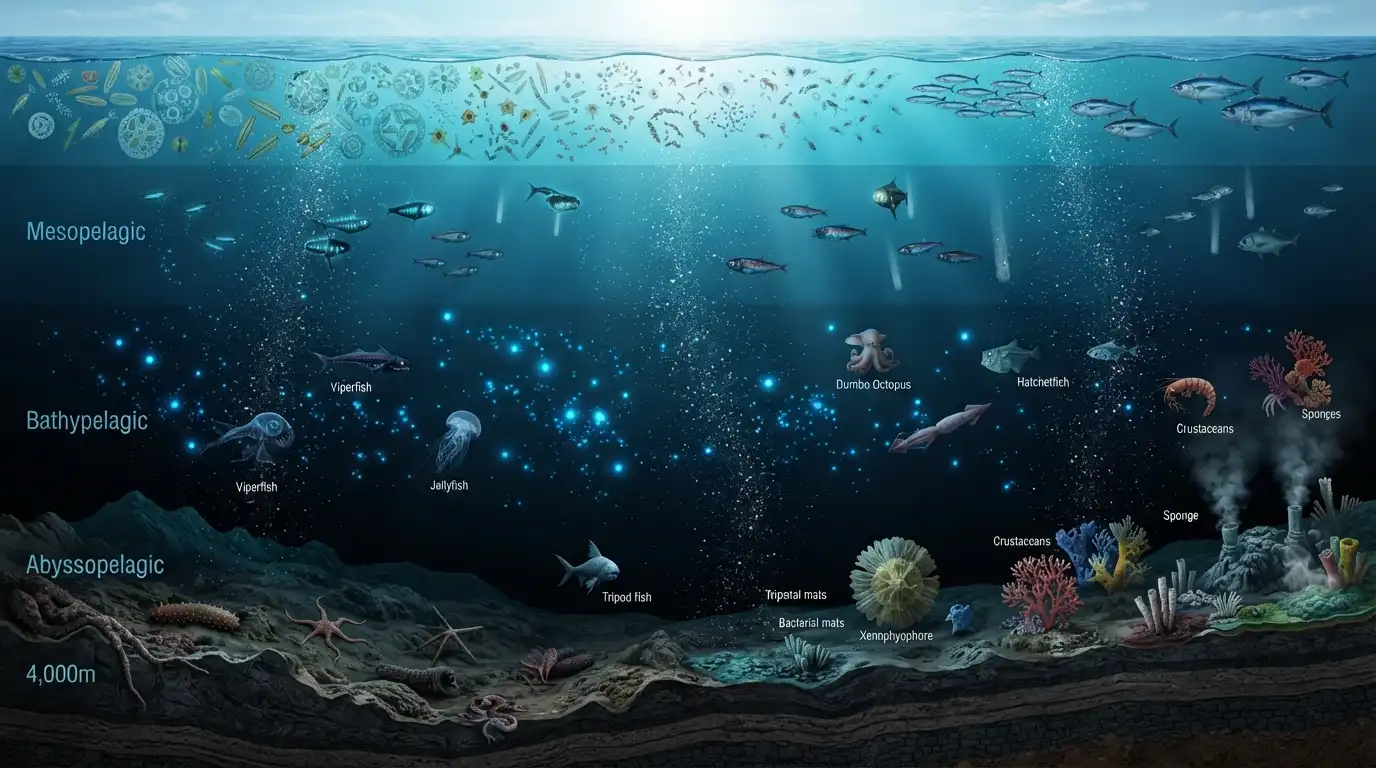
The journey of marine carbon begins in the euphotic zone—the upper layer of the ocean where sunlight penetrates. Here, microscopic single-celled algae known as phytoplankton utilize dissolved carbon dioxide and sunlight to perform photosynthesis, converting inorganic carbon into organic biomass.
Phytoplankton form the foundational base of the marine food web. When they are consumed by zooplankton, or when they die naturally, their organic carbon is packaged into denser structures. Cellular debris, dead organisms, and microscopic fecal pellets begin their long descent toward the ocean floor. This continuous downward shower of organic material is widely known to oceanographers as marine snow.
Marine Snow and the Abyssal Descent
As marine snow particles sink from the surface waters into the twilight zone (mesopelagic zone), they undergo continuous transformation. Bacteria and heterotrophic organisms consume a significant portion of this sinking organic matter, respiring it back into dissolved inorganic carbon (DIC) through microbial remineralization. This process releases carbon back into intermediate ocean waters, where it can remain isolated from the atmosphere for decades to centuries.
Nevertheless, a vital fraction of this organic carbon—alongside microscopic calcium carbonate and silicate shells produced by organisms like foraminifera and coccolithophores—escapes mid-depth degradation. These resilient particles settle out onto the abyssal plain, accumulating as pelagic sediments over thousands of years.
This long-term burial at the ocean floor provides a stable storage mechanism, effectively removing carbon from active surface and atmospheric exchange for geological epochs.
Connecting the Oceans to the Deep Carbon Cycle
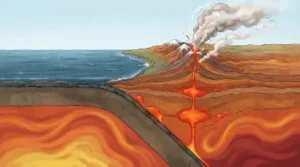
The carbon story does not end at the abyssal plain. Over millions of years, plate tectonics slowly reshapes the face of the Earth. As oceanic plates drift, the carbon-rich sediments accumulated on the seafloor are gradually conveyed toward subduction zones.
When an oceanic tectonic plate collides with and slides beneath a continental plate, these marine sediments are dragged deep into the Earth’s upper mantle. Under extreme heat and pressure, carbonate minerals undergo metamorphic decarbonation reactions. The carbon is either trapped in deep-seated mineral structures or melts into magma reservoirs.
Eventually, this deep carbon returns to the surface through volcanic outgassing along island arcs and mid-ocean ridges, completing a planetary loop that connects surface marine biology directly to the deep Earth interior.
Implications for Modern Climate and Geochemical Modeling
Understanding the efficiency of the biological pump is more than an academic pursuit; it is critical for projecting future climate scenarios. Shifts in ocean temperature, upper-ocean stratification, and ocean acidification directly impact phytoplankton community structures and metabolic rates, potentially altering the strength of the biological carbon sink.
By integrating modern oceanographic observations with deep-Earth geochemical modeling, scientists can better quantify how carbon cycles through every layer of our planet—from the crashing waves of the surface ocean down to the molten heart of the Earth.