
The Divergence of Surface Carbon Sinks
 To understand the scale of this transition, we must examine the planetary carbon budget. According to comprehensive tracking from the Global Carbon Project, the global ocean absorbs approximately 2.5 to 3 billion metric tons of carbon each year. As terrestrial carbon sinks experience heightened volatility due to extreme heat and shifting precipitation patterns, the ocean has become an even more dominant stabilizer of atmospheric CO2 concentrations.
Yet the ocean is not a bottomless sponge. Carbon absorption at the air-sea interface is governed by basic physical chemistry: cold water holds more dissolved gas than warm water. As global sea surface temperatures rise, the solubility of CO2 decreases. Simultaneously, warming surface layers become lighter and more stratified, reducing the vertical mixing that brings nutrient-rich, low-carbon deep waters to the surface. Understanding these competing mechanisms requires looking past the sunlit surface layer into the deep marine interior.
From Surface Uptake to Deep Marine Export
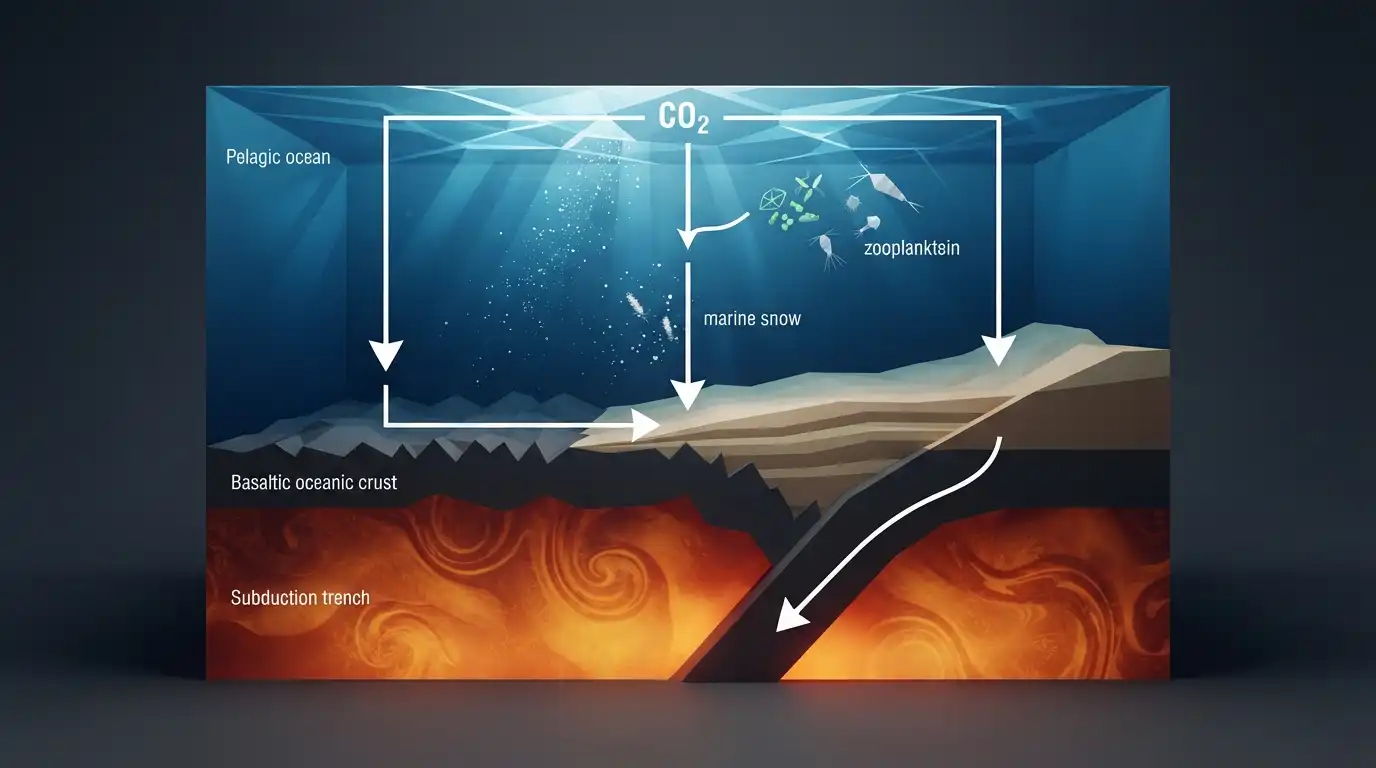
Once carbon dioxide dissolves into surface seawater, it reacts with water molecules to form carbonic acid, bicarbonate, and carbonate ions. For this dissolved inorganic carbon to be removed from atmospheric circulation for centuries or millennia, it must cross the permanent thermocline into the deep ocean. This downward transfer relies on two primary engines:
- The Solubility Pump: In high-latitude regions like the North Atlantic and the Southern Ocean, cold, dense, carbon-rich surface waters sink into the abyssal depths, driving global thermohaline circulation and isolating carbon from the atmosphere for up to a thousand years.
- The Biological Carbon Pump: Phytoplankton in sunlit surface waters convert dissolved CO2 into organic matter through photosynthesis. When these organisms die or are consumed by zooplankton, a fraction of this organic carbon aggregates into “marine snow”—fecal pellets, dead cells, and mineral shells—that sinks steadily toward the seafloor.
Research conducted by institutions such as the Woods Hole Oceanographic Institution demonstrates that only a tiny fraction—roughly 1% to 3%—of the organic carbon produced at the surface survives microbial consumption during its descent to reach the abyssal seafloor. However, over geological timescales, this continuous trickle of marine snow and calcium carbonate shells forms thick blankets of carbon-rich marine sediment, representing the critical handover point between the surface climate system and the deep carbon cycle.
Crossing the Boundary: Seafloor Burial and Subduction
When marine sediments settle onto the oceanic crust, carbon transitions from the hydrosphere into the lithosphere. Here, modern ocean sink dynamics directly intersect with deep-earth reservoirs. Oceanic tectonic plates are constantly on the move, carrying accumulated layers of carbonate ooze and organic-rich mud from mid-ocean ridges toward deep-sea trenches.
At subduction zones, the dense oceanic plate dives beneath an overriding continental or oceanic plate, dragging these carbon-bearing sediments deep into the Earth’s mantle. As pressure and temperature intensify with depth, subducted carbon undergoes dramatic metamorphic transformations:
| Carbon Reservoir / Pathway | Primary Mechanism | Residence Timescale |
|---|---|---|
| Surface Ocean Mixed Layer | Air-sea gas exchange and carbonate buffering | Years to decades |
| Deep Ocean Water Column | Thermohaline circulation and biological export | Centuries to 1,000+ years |
| Seafloor Marine Sediments | Carbonate burial and diagenesis | Millions of years |
| Earth’s Mantle via Subduction | Tectonic plate recycling and mineral storage | Tens to hundreds of millions of years |
Studies supported by the National Science Foundation have shown that a portion of this subducted carbon is stripped off by deep fluids and returned to the atmosphere relatively quickly—geologically speaking—through volcanic arc outgassing. However, a substantial fraction bypasses the volcanic zone entirely, descending hundreds of kilometers into the lower mantle where it is locked away in high-pressure mineral phases such as diamonds and deep-mantle carbonates.
Why Geological Timescales Cannot Rescue Modern Climate
Recognizing the physical connection between ocean carbon absorption and deep-earth subduction often leads to a common misconception: that Earth’s geological machinery will naturally absorb and bury our modern industrial emissions. While this feedback loop has successfully regulated Earth’s climate over billions of years, the mismatch in speed is staggering.
The silicate weathering thermostat and tectonic subduction operate on timescales of hundreds of thousands to millions of years. In contrast, human emissions are injecting carbon into the atmosphere-ocean system at a rate orders of magnitude faster than geological burial can match. Furthermore, as the ocean absorbs excess anthropogenic CO2, seawater chemistry shifts toward lower pH levels—a process known as ocean acidification, closely monitored by the National Oceanic and Atmospheric Administration.
Ocean acidification directly threatens the biological carbon pump. Lower carbonate ion concentrations make it harder for calcifying organisms—such as coccolithophores, foraminifera, and pteropods—to build their calcium carbonate shells. Because these dense mineral shells act as ballast that accelerates the sinking of marine snow, a decline in marine calcification could slow down the vertical export of carbon to the seafloor, weakening the very bridge that connects surface sinks to deep-earth storage.
Monitoring the Coupled Earth System
The shifting balance of modern ocean sink dynamics underscores a fundamental truth of Earth system science: the surface climate and the deep interior are not isolated realms. They are bound together by continuous physical, chemical, and biological fluxes that span from microscopic phytoplankton at the sea surface to descending tectonic slabs in the mantle.
As climate change alters ocean circulation, stratification, and seawater chemistry, tracking how efficiently carbon moves from the upper ocean into deep sediments becomes essential for refining long-term climate projections. Protecting the integrity of marine ecosystems and curbing surface emissions remain our most immediate levers, ensuring we do not overwhelm an oceanic carbon sink whose connection to deep-earth stability operates on a clock far slower than our own.