
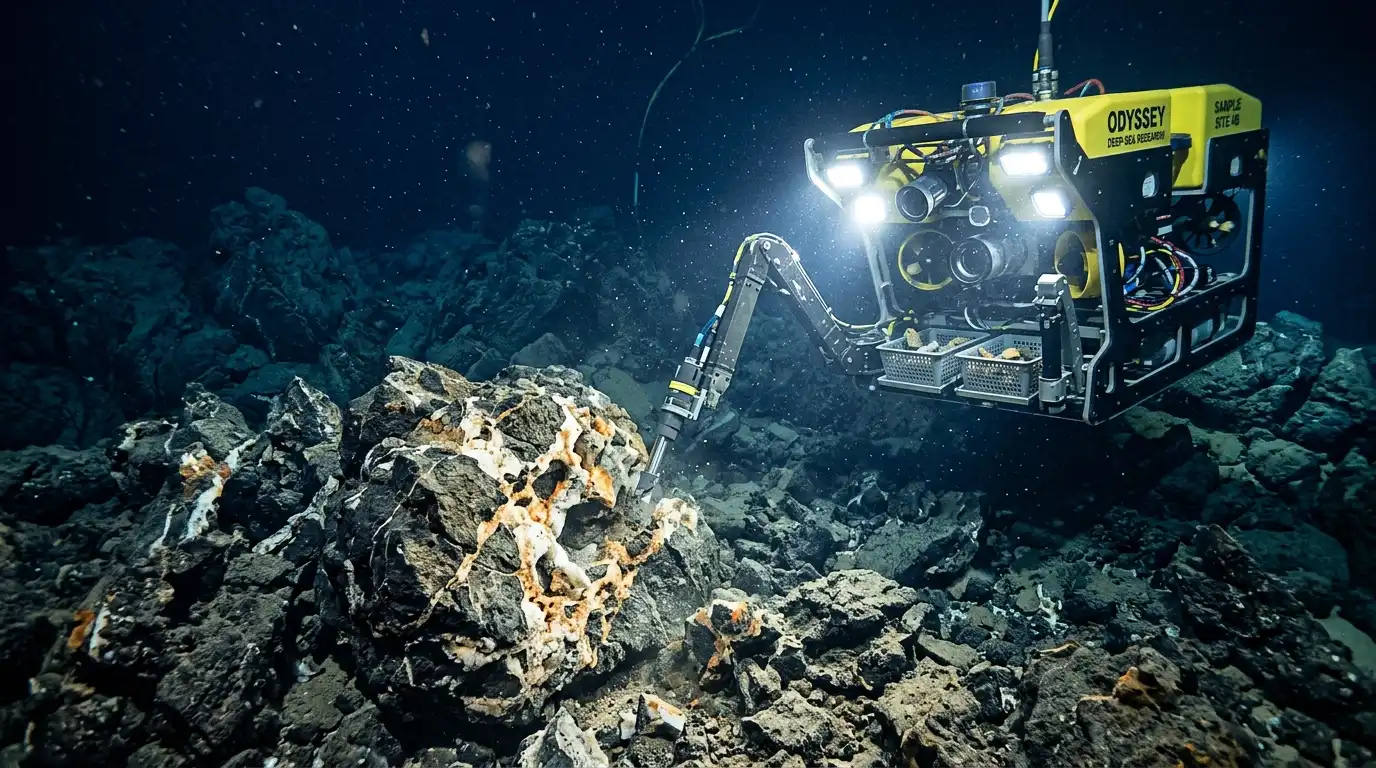
The deep carbon cycles aren’t just about rocks descending into Earth’s interior — the seafloor itself may hold a surprisingly large carbon reservoir. Recent research shows that ancient undersea lava rubble acts like a “sponge” for carbon dioxide (CO₂), storing far more carbon than previously thought and offering new insight into Earth’s long-term carbon dynamics.
Scientists drilling into 61-million-year-old ocean crust found volcanic breccia — broken fragments of undersea lava — with calcium carbonate filling pore spaces. These minerals contain between two to forty times more carbon dioxide per weight than typical upper ocean crust samples, suggesting that these rubble zones could be a significant, previously undercounted sink in the global carbon system.
What Makes Lava Rubble a Carbon Reservoir
 Undersea lava rubble forms at mid-ocean ridges, where tectonic plates pull apart and magma rises to create new crust. Over millions of years, seawater interacts with this crust, converting CO₂ into stable carbonate minerals that fill cracks and voids. Rather than remaining dissolved in water or quickly returning to the atmosphere, this carbon becomes locked in rock deep beneath the waves.
These carbonate-rich breccias may act as long-term carbon sinks analogous to sedimentary carbonates that eventually subduct into the mantle — connecting surface ocean processes to the deep carbon cycle in ways researchers are just beginning to quantify.
What This Means for the Deep Carbon Cycle
This discovery reframes part of the global carbon budget, highlighting an underexplored mechanism of stable carbon storage on geological timescales. If undersea lava rubble stores significant carbon, this reservoir may:
- Influence how much carbon ultimately enters subduction zones and the mantle.
- Affect models of volcanic CO₂ release, linking seafloor storage with mantle degassing and tectonic carbon pathways.
- Provide new context for tying surface ocean carbon sequestration to deeper geological processes.
This geological carbon sponge echoes mechanisms discussed in other deep carbon cycle research such as Carbon Leakage from Continental Rifting and pathways for Abiogenic Hydrocarbons in the Upper Mantle, expanding the narrative of Earth’s deep carbon pathways beyond subduction and volcanism. (See also: Carbon Leakage from Continental Rifting, Abiogenic Hydrocarbons in the Upper Mantle.)
Why This Discovery Matters
Most carbon budgets focus on atmospheric, biospheric, and shallow oceanic reservoirs. The identification of a solid-phase carbon reservoir in undersea lava rubble suggests Earth’s carbon is stored in more complex ways and over longer timescales than assumed — a key theme in understanding Earth’s carbon stability, climate history, and geological evolution.