
When most people think about Earth’s carbon, they picture the atmosphere, oceans, forests, or fossil fuels. Carbon is often discussed in the context of climate change, emissions, and surface ecosystems.
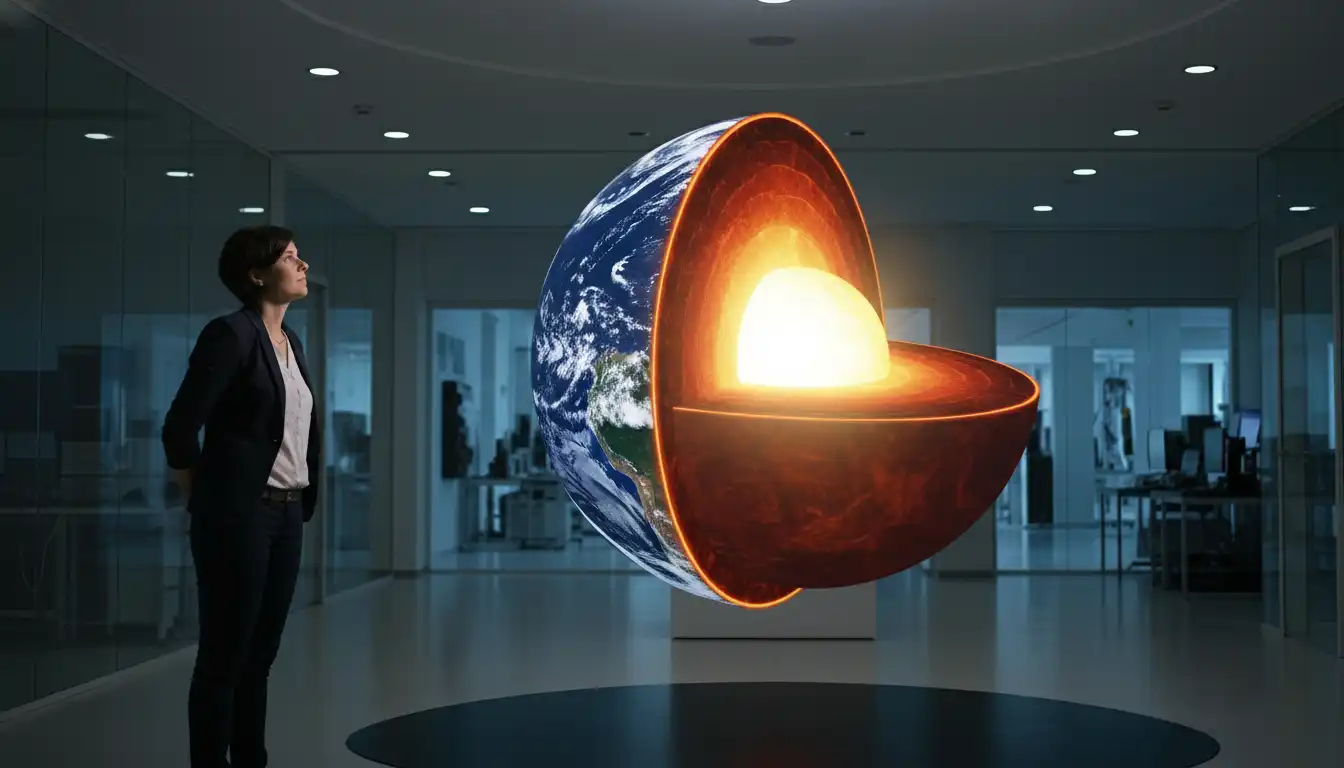
But Earth’s carbon story extends far deeper than the surface. In fact, the majority of Earth’s carbon may not be found in the air or oceans at all. Instead, it may be stored deep within the planet’s interior, hidden from direct observation.
One of the most fascinating questions in deep Earth science today is whether enormous amounts of carbon are locked away in Earth’s core. In 2026, new experimental research and geochemical modeling are bringing renewed attention to this possibility, suggesting that the core may represent one of Earth’s largest and least understood carbon reservoirs.
The Deep Carbon Cycle Beyond the Surface
 The deep carbon cycle refers to the movement of carbon between Earth’s surface and its interior over geological time. Unlike the fast carbon cycle, which involves photosynthesis, respiration, and ocean-atmosphere exchange, the deep carbon cycle operates on timescales of millions to billions of years.
Key processes in the deep carbon cycle include:
- Subduction of carbon-rich sediments into the mantle
- Storage of carbon in deep mantle minerals
- Release of carbon through volcanic outgassing
- Long-term sequestration in Earth’s interior
These deep processes play an important role in regulating atmospheric carbon dioxide over Earth’s history, influencing climate stability across vast stretches of time.
Earth’s Core as a Potential Carbon Storage Zone
Earth’s core makes up about one-third of the planet’s total mass. It consists primarily of iron and nickel, but scientists have long suspected it also contains lighter elements.
Carbon is one of the leading candidates for these lighter components. During Earth’s early formation, when the planet was molten and undergoing differentiation, heavy metallic elements sank to form the core. Some carbon may have been drawn downward during this process, dissolving into the iron-rich core instead of remaining entirely in the mantle or crust.
If even a small fraction of Earth’s carbon entered the core billions of years ago, the total amount stored there could be enormous, potentially exceeding all carbon found in the atmosphere, oceans, and surface rocks combined.
Why Scientists Are Reexamining Core Carbon in 2026
Interest in carbon storage within Earth’s core has grown in recent years due to major advances in experimental techniques and modeling approaches.
High-Pressure Laboratory Experiments
Researchers can now recreate core-like pressures and temperatures using advanced tools such as diamond anvil cells and shock compression experiments.
These methods allow scientists to test how carbon behaves when mixed with molten iron under extreme conditions. Results increasingly suggest that carbon may dissolve more readily into metallic liquids than previously assumed.
This supports the idea that Earth’s core could hold substantial amounts of carbon, stored since the planet’s earliest history.
Geochemical Signals from Deep Mantle Sources
Some volcanic eruptions originate from deep mantle plumes, bringing material from far below the crust to the surface.
Isotopic signatures in these volcanic rocks sometimes show carbon sources that appear ancient and isolated. Scientists are exploring whether these signatures could reflect interactions between deep mantle reservoirs and the core-mantle boundary.
Planetary Comparisons and Meteorite Evidence
 Studies of meteorites and planetary formation models suggest carbon may commonly partition into metallic cores during differentiation.
If this process occurred on Earth, it may also occur on other rocky planets, making core carbon storage a broader planetary phenomenon.
What Core Carbon Could Mean for Earth’s Carbon Budget
Earth’s carbon budget is an attempt to account for where carbon is stored across the planet. Known reservoirs include:
- The atmosphere
- The oceans
- The biosphere
- Carbonate rocks in the crust
- The mantle
If the core contains a major fraction of Earth’s carbon, then the planet’s total carbon inventory may be far larger than surface-based estimates suggest.
This could reshape how scientists understand the origin of Earth’s atmosphere, the evolution of oceans, and the long-term sources of volcanic carbon emissions.
Does Carbon in the Core Participate in the Deep Carbon Cycle?
A key question is whether carbon stored in the core is completely locked away or whether it interacts with the mantle over time.
Most researchers believe the core is highly isolated, meaning carbon stored there would remain inaccessible for billions of years. However, some hypotheses suggest slow exchange may occur at the core-mantle boundary through chemical reactions or thermal processes.
Possible mechanisms include:
- Core-mantle boundary reactions involving iron and carbon compounds
- Deep mantle plume formation transporting material upward
- Long-term thermal evolution affecting boundary chemistry
Even rare interactions could influence Earth’s deep carbon fluxes over geologic time.
Why This Research Matters Beyond Geology
Understanding carbon in Earth’s core is not only a geological question. It connects to broader scientific issues, including:
- How habitable planets evolve over time
- How carbon regulates long-term climate stability
- Where Earth’s carbon originated during formation
- How deep reservoirs shape surface environments
The possibility of a hidden core carbon reservoir reminds us that Earth’s carbon cycle is far larger and deeper than what we observe at the surface.
Internal Links for Readers Exploring Deep Carbon Topics
For readers interested in other deep carbon questions, these related articles may also be useful:
- Carbon Leakage from Continental Rifting
- Abiogenic Hydrocarbons in the Upper Mantle
- About the Deep Carbon Cycle Project
Conclusion
In 2026, growing evidence suggests Earth’s core may represent one of the planet’s most significant hidden carbon reservoirs. While much remains unknown, ongoing high-pressure experiments and deep Earth geochemistry are bringing new clarity to the role carbon may play far beneath the mantle.
If Earth’s core holds vast amounts of carbon, it may reshape how scientists understand the deep carbon cycle, planetary evolution, and Earth’s long-term carbon stability.
As research continues, the idea of a deep planetary carbon reservoir reminds us that Earth’s carbon story extends far beyond the surface, into the deepest layers of the planet itself.