
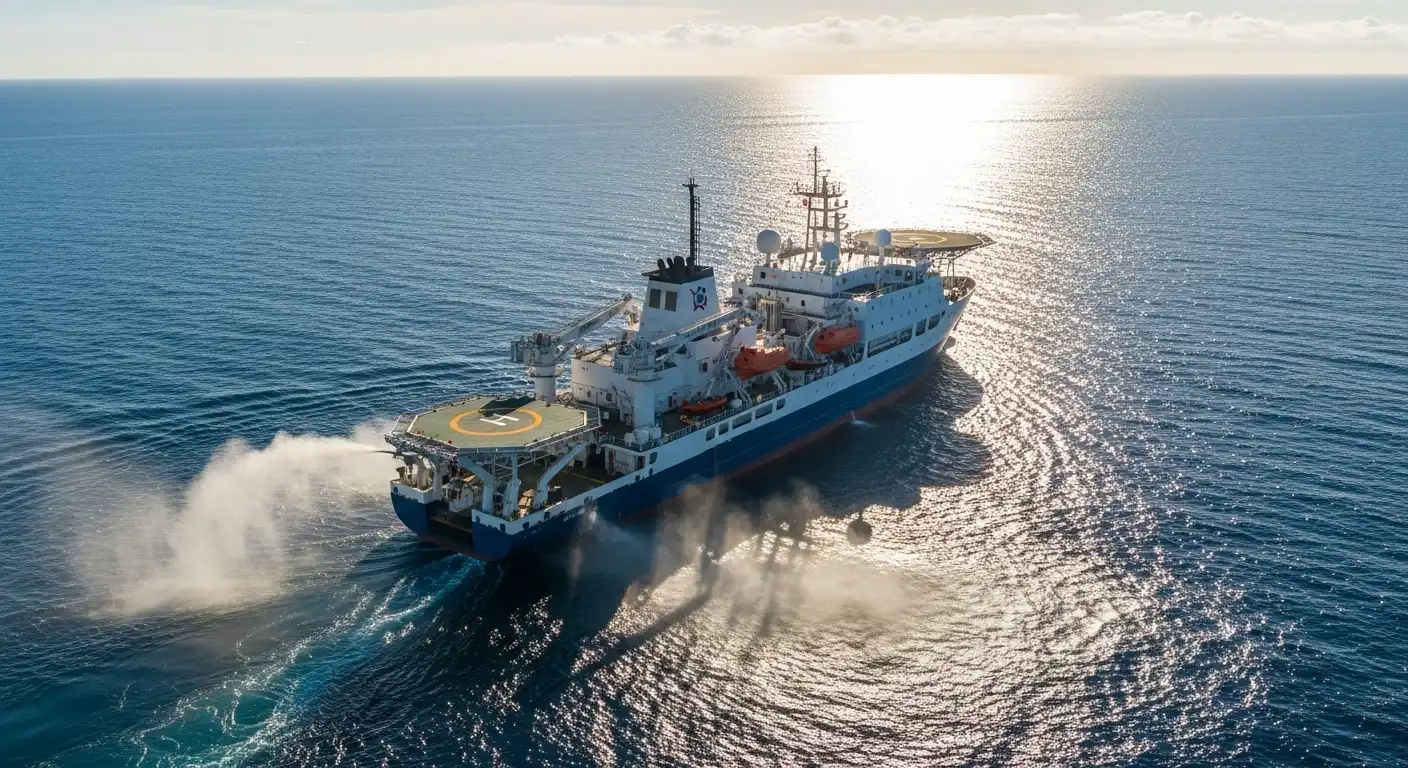
As the world explores large-scale methods to mitigate climate change, Ocean Alkalinity Enhancement (OAE) has emerged as a promising carbon removal strategy. By adding alkaline materials such as crushed minerals to seawater, OAE increases the ocean’s capacity to absorb and store atmospheric CO2. But this process doesn’t just affect surface chemistry—it links directly to the deep carbon cycle, the set of processes that govern carbon exchange between Earth’s surface, crust, and mantle over geologic time.
Understanding the Deep Carbon Cycle
The deep carbon cycle is the planet’s long-term carbon engine. Carbon travels from the atmosphere into the ocean, becomes locked into marine sediments, and over millions of years, subducts into Earth’s mantle. Volcanic activity then releases some of this carbon back into the atmosphere, completing a slow but crucial cycle that regulates Earth’s climate stability.
Human-driven CO2 emissions, however, have upset this natural balance. While the surface carbon cycle operates on decades to centuries, the deep carbon cycle functions over millions of years—too slow to counteract rapid industrial emissions. OAE offers a bridge between these timescales, potentially enhancing carbon storage in ways that echo deep carbon pathways.
How Ocean Alkalinity Enhancement Works
OAE involves dispersing alkaline materials such as olivine, basalt powder, or calcium hydroxide into seawater. These materials react with dissolved CO2 to form bicarbonate and carbonate ions, effectively converting gaseous carbon into stable, dissolved forms. This chemical shift increases the ocean’s buffering capacity and reduces acidification.
When deployed responsibly, OAE could create long-lasting carbon storage within the ocean. Some of this carbon may eventually precipitate as carbonate minerals, settle into marine sediments, and—over geological time—become part of the subducted carbon reservoirs that sustain the deep carbon cycle.
Recent Advances in OAE Modeling
Recent Earth system and biogeochemical models have started to explore how large-scale OAE might behave over time. These studies highlight key findings:
- Regional variability matters. Simulations show that the effectiveness of OAE depends on where and when materials are added. Regions with strong vertical mixing or upwelling tend to distribute alkalinity deeper into the ocean, enhancing durability.
- Carbon permanence is linked to circulation. Water masses that exchange slowly with the atmosphere—such as those in the deep Pacific—can store carbon for hundreds to thousands of years before resurfacing.
- Monitoring is essential. Scientists emphasize that verifying carbon removal requires tracking alkalinity, dissolved inorganic carbon, and CO2 fluxes across spatial and temporal scales.
From the Surface to the Seafloor: OAE’s Connection to the Deep Carbon Cycle
 Though OAE operates on human timescales, its chemistry mirrors the same reactions that drive carbonate formation in marine sediments. By enhancing alkalinity at the surface, OAE could subtly influence carbonate deposition and sediment preservation on the seafloor.
Carbonate sediments are vital to the deep carbon cycle because they act as the long-term sink for carbon before it is recycled into the mantle. An increase in surface ocean alkalinity could promote the formation of more stable carbonates, creating a small but measurable feedback to the geological record.
This link between engineered carbon removal and natural geological processes highlights why OAE research increasingly involves geochemists and Earth system scientists who study deep-Earth carbon pathways.
Potential Risks and Environmental Safeguards
While OAE’s promise is significant, its deployment must be carefully managed. Adding alkalinity can alter local pH, impact marine life, and affect nutrient cycles. For example, shifts in carbonate chemistry may influence organisms like corals and plankton that rely on stable pH for shell formation.
To minimize ecological disturbance, researchers propose small-scale field experiments with real-time monitoring. Transparent, open-access data sharing and environmental modeling are central to ensuring OAE contributes to climate goals without creating unintended consequences.
Global Efforts and Policy Frameworks
Initiatives such as the Carbon to Sea Project and Ocean Alkalinity Enhancement Modeling Intercomparison Project (OAEMIP) are coordinating global research to standardize modeling frameworks, field protocols, and measurement, reporting, and verification (MRV) guidelines. These projects aim to quantify the real carbon benefit of OAE and identify regions suitable for pilot deployment.
Moreover, international policy discussions under the London Protocol and the United Nations Decade of Ocean Science are shaping how ocean-based carbon dioxide removal fits within global climate strategies.
Connecting OAE to Existing Deep Carbon Research
 Readers of DeepCarbonCycle.org are already familiar with topics like mantle redox control, subducted carbon storage, and volcanic degassing. OAE extends this narrative by operating at the interface of biology, chemistry, and geology.
Where the mantle releases carbon through volcanic outgassing, OAE represents a potential human-driven pathway for accelerating oceanic uptake and extending carbon residence times. Together, these processes frame the Earth system’s dynamic carbon balance—from the atmosphere to the ocean, sediments, and deep mantle.
Future Research Priorities
- Long-term permanence: Quantifying how long alkalinity-induced carbon stays sequestered, particularly as ocean circulation redistributes dissolved inorganic carbon.
- Ecological thresholds: Determining how much alkalinity can be safely added without harming marine ecosystems or altering nutrient balances.
- Coupled modeling: Integrating OAE simulations into global carbon cycle and Earth system models that include sediment feedbacks and subduction fluxes.
- Monitoring frameworks: Developing standardized MRV methods that can validate net carbon removal on regional and global scales.
Why OAE Matters for the Deep Carbon Community
Studying OAE helps scientists bridge the timescales of human-driven carbon management and geologic carbon cycling. By comparing engineered alkalinity processes with natural mineral dissolution, carbonate precipitation, and subduction feedbacks, researchers can refine both short-term climate strategies and long-term planetary models.
Final Thoughts
Ocean Alkalinity Enhancement is still in its experimental stage, but it carries the potential to reshape how humanity interacts with the ocean carbon system. Its relationship with the deep carbon cycle underscores that every layer of Earth—from the surface ocean to the mantle—plays a role in stabilizing climate over time.
As research advances, collaboration between ocean chemists, geologists, and climate modelers will be essential to ensure that OAE becomes not only a tool for carbon removal but also a window into understanding our planet’s most fundamental processes.